
Starbucks Calorie Calculator: Know Your Drink Before You Sip
· A cookie has a printed calorie count. A Starbucks drink does not. Here’s how size, milk, syrup pumps, and toppings move the total, and how a calculator shows your real order.
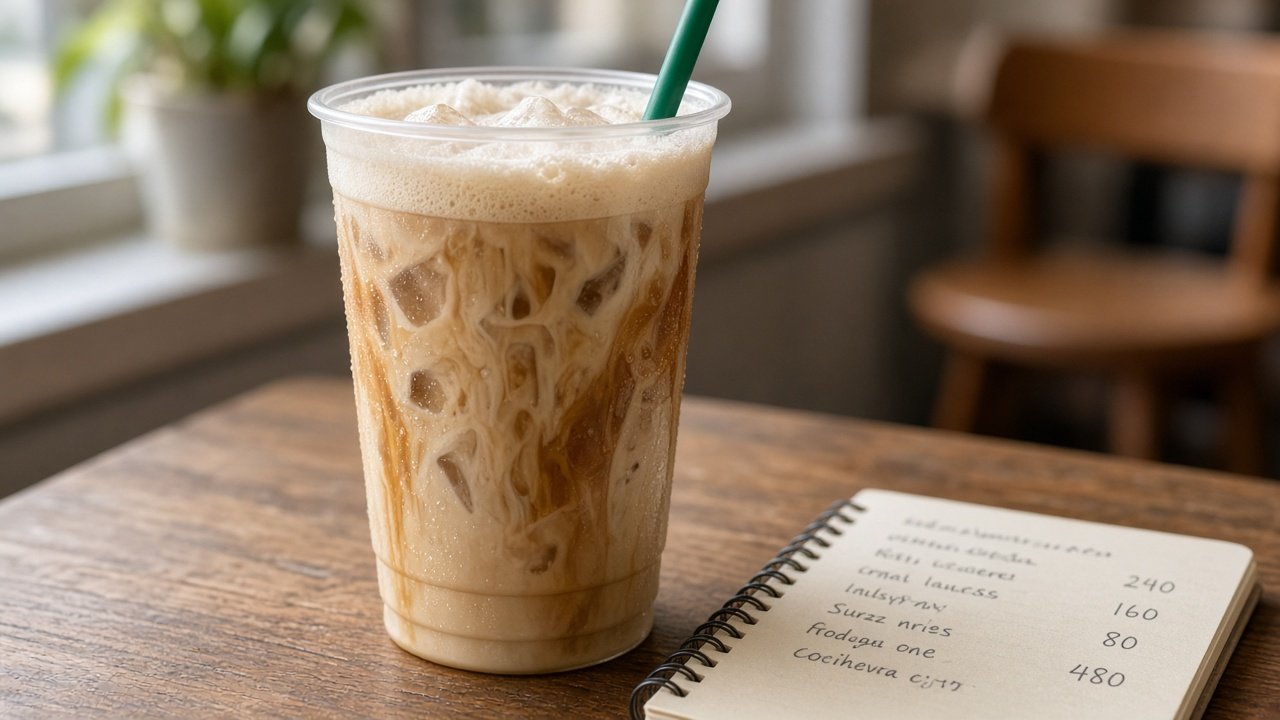
Your cookie has a label. Your drink does not.
If you follow the weekly Crumbl board, you already check the number before you order. That habit is useful.
A single cookie can run from about 300 to over 700 calories. Frosted ones sit higher than plain ones. The app lists it all if you tap through.
Here is the gap. Almost nobody eats a cookie dry. There is a drink in the other hand. It might be a latte, a cold brew, or something blended with whipped cream.
That drink is often the larger half of the total. A cookie has a fixed calorie count. A drink does not. It changes with every choice at the counter. None of those choices are printed on the board.
That is the problem a Starbucks Calorie Calculator is built to solve.
Why the menu board can't give you a straight answer
Walk into any Starbucks and look at the board. You will see drink names and prices. You will not see a calorie figure for the drink you are about to order.
That drink does not exist yet. It gets assembled.
Published nutrition charts have the same limit. They list a standard build. That means one size, the default milk, the default syrup pumps, and the recipe toppings.
The moment you say “grande, oat milk, two pumps instead of four, no whip,” the chart describes a different drink than the one in your cup.
This is not a small gap. The same named drink can swing by 200 calories or more. Those changes take about three seconds to request.
A calculator works the other way. You build your actual order. Then you watch the total move as you change it.
The four variables that move the number most
Once you model drinks instead of looking them up, a clear pattern shows. Four choices drive most of the change.
1. Size
Tall, Grande, and Venti are not just more liquid. They are more of everything. A larger cup usually brings more milk, more syrup, and more base.
Dropping one size is often the fastest cut. You do not need to negotiate with the barista.
2. Milk
This is where most people are surprised.
Whole milk, 2%, nonfat, oat, almond, soy, and coconut all carry different calorie and sugar loads. In a large milk-based drink, the gap between the heaviest and lightest option is big.
Almond is usually the lightest. Oat has a healthy reputation, but it often sits closer to whole milk. That is because of how it is made for steaming.
3. Syrup pumps
Each pump of standard syrup adds about 20 calories. Almost all of that is sugar. Default pump counts rise with cup size.
A large sweetened drink may already have four to six pumps. Asking for half the pumps is a small taste change. It is one of the strongest cuts to the total.
4. Toppings
Whipped cream, drizzle, cold foam, and crumble toppings are all add-ons. They are also optional.
Whipped cream alone often adds about 70 to 110 calories, based on size. It is the easiest item on this list to remove.
These numbers are estimates. That is the point. The only way to get the real figure for your build is to enter it.
A calculator does the math across all four variables at once. That is more than most people can do in their head while a line forms behind them.
How to use the calculator in under a minute
The tool is free. It runs in a browser. You need no account and no download. The flow is short:
- Pick your base drink. Espresso drinks, cold brews, teas, refreshers, and Frappuccinos are covered.
- Choose your size. Tall, Grande, or Venti.
- Set your milk. Dairy or any plant option.
- Adjust syrup and sweetener. Use the pump count you actually order, not the default.
- Add or remove toppings. Whipped cream, foam, drizzle, and the rest.
- Read the result. You get total calories, plus sugar, carbs, protein, and fat. Where the data exists, you also get caffeine.
Most people open a calculator for calories. Many stay for caffeine. That helps if you are ordering a second drink, if you are pregnant, or if you have noticed that a blended drink and a cold brew feel very different at 4 p.m.
Practical ways to cut the total without hating your drink
Some advice works on paper but fails in real life. Ordering black coffee is one example. These changes are easier to keep:
- Halve the pumps first. Most sweetened drinks are sweeter than you need. Going from four pumps to two is rarely missed.
- Swap the milk, keep the drink. Almond or nonfat keeps the same recipe and cuts a real share of the calories.
- Skip the whip, keep the drizzle. If you want the look and the flavor note, the drizzle costs far less than the cream.
- Go iced when it fits the drink. Iced builds often use less milk than hot drinks in the same cup size.
- Order one size down and drink it slower. Simple. Effective. Free.
- Try cold foam instead of a blended base. You still get texture and richness for a fraction of the calories.
Three things people get wrong
“Iced automatically means lighter.” Not always. An iced drink with lots of syrup and sweet cream foam can beat a plain hot latte. Temperature is not the main driver. Syrup and dairy are.
“Plant milk is always the low-calorie choice.” Almond usually is. Oat and coconut often are not. Soy sits in the middle. The category label does not help. The specific milk does.
“Sugar-free syrup makes the drink calorie-free.” It removes the syrup calories, not the drink calories. A sugar-free vanilla latte is still mostly milk. Milk is where most of the remaining calories live.
Where this meets your cookie run
If you already check the Crumbl board before you order, you are doing the hard half of the work.
Adding the drink takes about forty seconds. It closes the gap between what you think you ordered and what you actually did.
A cookie plus a careful drink is not the same as a cookie plus a default large blended drink. From the outside, they can look identical.
Nobody is saying you should stop ordering either one. The point of the numbers is not restriction. It is knowing which lever to pull on the day you want to pull one. On other days, you can ignore it.
Start with your usual order
The best first run is not a drink you are considering. It is the one you already order every week without thinking.
Enter it exactly as you get it. Most people find the number is lower than they feared, or higher than they assumed by enough to explain a few things.
Once you know your baseline, the changes become clear.
If you want to go further than calories, the companion guide on Customize Your Starbucks Drink & Cup covers the rest. It walks through milk, sweetener, cold foam, roast mixing, and how to phrase a custom order at the counter without holding up the line.
Common questions
Is a Starbucks calorie calculator accurate?
It combines official nutrition data with ingredient-level math. That makes it a close estimate. In-store pours vary a little, so treat the result as a reliable guide, not a lab figure.
Does it handle secret menu drinks?
Yes, if the ingredients are in the system. Secret menu items are unusual mixes of standard parts, so building them by hand usually works.
Does a Starbucks calorie calculator cost anything?
No. It is free. It also runs on a phone browser, which is where you will need it.
What if my drink isn’t listed?
There is a feedback path for missing drinks and errors. That is how the database keeps up with seasonal menu changes.