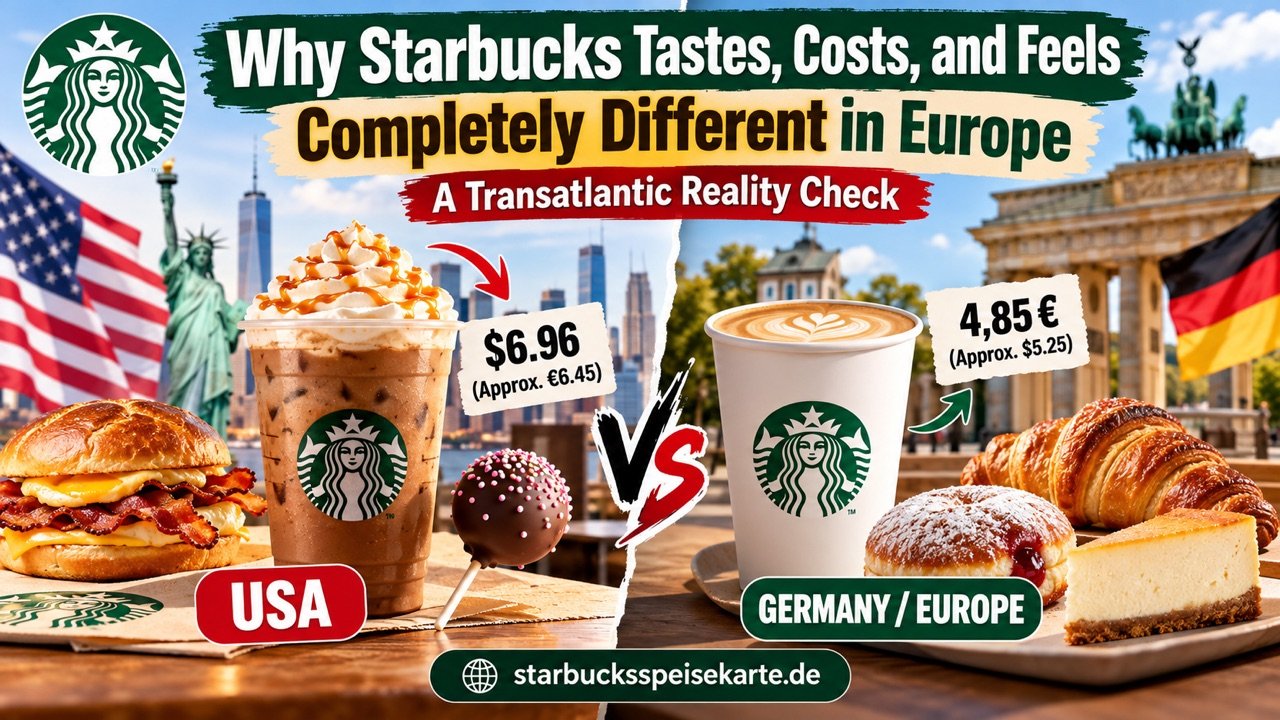
Why Starbucks Tastes, Costs, and Feels Completely Different in Europe
· A transatlantic reality check on Starbucks prices, tipping, cup sizes, EU ingredients, bakery food, free non-dairy milk, and café culture in Europe vs. the US. Current items and prices are on the Starbucks Menü guide.
- Brand
- Starbucks
- Compared
- United States vs. Germany and Western Europe
- Grande latte, out of pocket
- About $6.96 in the US vs. 4,85 € in Germany
Starbucks in Europe vs. the US at a glance
Starbucks in Europe feels different because prices include tax and no tip is expected, there is no Trenta, EU rules change the syrups and colorings, the food case leans on real bakery items, non-dairy milk has long been free, and stores still work as sit-down cafés.
Walk into a Starbucks in downtown Seattle or midtown Manhattan, and the rhythm is practically muscle memory: you tap your order into a smartphone app, roll through a drive-thru or grab a paper cup off a crowded mobile-pickup counter, and head out the door within four minutes.
Step inside a Starbucks across the Atlantic, whether on Berlin's Kurfürstendamm, near Paris's Opéra Garnier, or in central Munich, and the experience feels almost surreal to an American traveler. People are actually sitting down. Acoustic jazz hums in the background. Hot drinks are served in heavy porcelain mugs, and the display case doesn't look like an airport grab-and-go cooler; it looks like a local artisan bakery.
While the iconic two-tailed green siren is identical on both continents, almost everything else, from the price you pay at the register and the volume of coffee in your cup to the makeup of your syrup, operates under an entirely different playbook.
If you are planning an overseas trip or wondering why your favorite iced latte tasted so different during your European vacation, here is an unfiltered reality check of how Starbucks in Europe compares to its American flagship.
1. The True Cost Paradox: Why European Starbucks Is Cheaper Than It Looks
For years, a persistent myth has circulated on travel forums: Starbucks is insanely expensive in Europe compared to the US.
On paper, it is easy to see why. A Grande Caffè Latte in Germany is listed on the menu board for around 4,85 € to 4,95 €. At rough exchange-rate parity, an American tourist might think: “My local Starbucks back in Ohio only charges $4.95. Why pay the same in Europe?” The answer lies in what happens after you order.
| Cost line | 🇺🇸 United States | 🇪🇺 Germany / Europe |
|---|---|---|
| Menu board price | $4.95 | 4,85 € |
| Sales tax / VAT | +$0.42 (8.5% state & local tax) | 0,00 € (19% VAT already included) |
| Tip | +$0.89 (18% digital prompt) | 0,00 € (not expected) |
| Non-dairy milk | +$0.70 (historical surcharge) | 0,00 € |
| Final out-of-pocket | ~$6.96 (approx. €6.45) | 4,85 € (approx. $5.25) |
The US pricing trap: net + tax + tip
In the United States, menu prices are listed before state and municipal sales tax, which commonly adds 6% to 10.25% at checkout. On top of that, digital point-of-sale terminals flip a screen toward you prompting a 15%, 18%, or 20% tip.
Until the recent reform under CEO Brian Niccol, American customers also paid an extra $0.70 to $0.80 just to substitute oat or almond milk. That meant a single customized latte routinely climbed past $6.50 to $7.00.
The European transparency model
In Western Europe, consumer protection laws require displayed prices to be gross prices, inclusive of Value Added Tax (19% in Germany).
European baristas also work under national collective bargaining agreements, such as the BdS Gastronomie-Tarifvertrag in Germany, with a baseline wage, paid vacation, and health insurance. As a result, leaving a tip on a counter coffee order is optional and rarely expected.
According to an in-depth transatlantic Starbucks price comparison, once tax, labor structures, and dairy customization are factored in, Americans frequently pay 15% to 25% more out of pocket per drink than their European counterparts.
2. Cup Sizing: The Mystery of the Missing Trenta
If you rely on a colossal 31-ounce iced beverage to get through your morning commute, Europe will deliver a swift wake-up call.
In the United States, the cold drink lineup extends to the Trenta (916 ml / 31 fl oz), a cup that holds more liquid than an average adult stomach comfortably fits. In Europe, the Trenta does not exist.
| Size | 🇺🇸 United States | 🇪🇺 Germany / Europe |
|---|---|---|
| Short | 236 ml (8 oz), off-menu | 236 ml (8 oz), on the menu |
| Tall | 354 ml (12 oz) | 354 ml (12 oz) |
| Grande | 473 ml (16 oz) | 473 ml (16 oz) |
| Venti (hot) | 591 ml (20 oz) | 591 ml (20 oz) |
| Venti (iced) | 709 ml (24 oz) | 591 ml (20 oz)* |
| Trenta (iced) | 916 ml (31 oz) | Not offered |
* In many European stores, cold Venti drinks are calibrated to 591 ml rather than the 24 oz (709 ml) standard used in the US.
Why did Europe reject the giant cup?
It isn't a supply chain limitation; it is a cultural divide. Traditional European coffee culture, rooted in Italian espresso and Austrian café traditions, treats coffee as a concentrated drink meant to be savored fresh before it cools or dilutes. Sipping nearly a liter of iced milk coffee over four hours while driving is a uniquely American habit.
To order the right volume without awkward conversions, check this guide to European Starbucks cup sizes and milliliters before stepping up to the counter.
3. The Ingredient Shakeup: Why European Drinks Taste Less Artificial
Ask any American expat in Europe about their first sip of an iced caramel macchiato abroad, and the verdict is almost universal: it tastes less sweet, richer in dairy, and cleaner on the palate. That difference isn't an accident; it is food chemistry.
EU food safety (EFSA) vs. US FDA standards
The European Food Safety Authority enforces some of the strictest additive rules in the world, and that changes how Starbucks recipes are formulated for European stores.
- No synthetic petroleum dyes. Bright US specialty drinks can rely on artificial dyes like Red 40, Yellow 5, and Yellow 6, which in the EU require a warning that they “may have an adverse effect on activity and attention in children.” In Europe, Starbucks colors Refreshers and seasonal drinks with natural sources such as beetroot extract, purple carrot concentrate, and spirulina.
- Beet sugar vs. high-fructose corn syrup. Many US syrup formulas lean on inexpensive high-fructose corn syrup, while European Starbucks syrups are sweetened mainly with beet and cane sugar. The sweetness is less sharp, without a lingering aftertaste.
- Higher milk fat. European full-cream milk carries more butterfat than standard US whole milk, which makes a denser, silkier microfoam for cappuccinos and flat whites.
4. The Food Case: Thaw-and-Serve vs. Real Bakery Craft
If there is one category where Europe outclasses its American sibling, it is the food counter.
In a typical US Starbucks, food is utilitarian: breakfast sandwiches, egg bites, and cake pops arrive frozen from central distribution, sit wrapped in a refrigerated case, and are warmed in a high-speed convection oven.
In Europe, and particularly in Germany, France, and Switzerland, Starbucks has had to adapt to a continent that takes bakery culture very seriously. If a German café served a soggy, defrosted roll, locals would walk across the street to the nearest Bäckerei.
| 🇺🇸 Typical US Starbucks food | 🇪🇺 Typical German Starbucks food |
|---|---|
| Bacon, Gouda & Egg Sandwich | Freshly baked butter croissants |
| Double-Smoked Bacon Cheddar | Focaccia Caprese with pesto |
| Turkey Bacon & Egg White Wrap | German Berliners (Krapfen) |
| Birthday Cake Pop | Multigrain Laugenzopf (pretzel braid) |
| Packaged Marshmallow Dream Bar | New York cheesecake by the slice |
Instead of generic heat-and-eat items, European Starbucks cases feature Caprese focaccia on rosemary flatbread, butter-pretzel pastries, Belgian Liège waffles, and jam-filled Berliners. The bread has a crisp crust, the mozzarella is fresh, and pastries sit on open display boards rather than in sealed bags. For current German items and prices, see the Starbucks Menü.
5. The Dairy Revolution: How Germany Beat the US by Years
In late 2024, when Starbucks CEO Brian Niccol announced that US stores would drop the extra charge for non-dairy milk (oat, almond, soy, and coconut) starting with the holiday menu, American media hailed it as a big win for consumers.
European coffee drinkers mostly shrugged. Germany and several other European markets had already abolished the non-dairy surcharge years earlier.
Driven by customer demand and campaigning from sustainability groups, Starbucks Germany charges 0,00 € to swap in oat milk (Oatly Barista Edition), soy milk, or almond milk. Whether you order a hot flat white or an iced pumpkin spice latte, the price is the same regardless of dietary or ethical choices.
6. Cultural Atmosphere: The Third Place Still Lives in Europe
In the United States, Starbucks has deliberately become a transaction machine. Roughly 70% of new US stores include a drive-thru, and mobile order-and-pay lanes move customers in and out with minimal interaction. Seating has been quietly downsized, and power outlets are increasingly capped or removed.
In Europe, the original Starbucks vision, the Italian café as an inviting third place between home and office, is still very much alive.
- For here means porcelain. Unless you ask for your coffee „zum Mitnehmen“ (to go), baristas pour it into a pre-warmed porcelain cup and serve your pastry on a real plate with a metal fork.
- Lingering is encouraged. Students and remote workers routinely sit for hours with a single espresso and a laptop on free Wi-Fi without anyone hovering.
- Bring-your-own-cup savings. Bringing a reusable tumbler isn't just appreciated; it earns a direct discount, typically 0,30 € off per drink.
7. Pro Tips for Americans Ordering Starbucks in Europe
If you find yourself overseas craving your morning caffeine fix, keep these in mind.
- Your US app won't work for payment. Starbucks runs separate regional systems. You cannot scan your US app at a German, French, or Italian register or transfer US Stars or gift card balances. Pay by credit card, Apple Pay, or cash.
- Filter coffee isn't the default. In the US, ordering a “coffee” gets you batch-brewed Pike Place. In Europe, asking for coffee usually gets you an Americano (espresso diluted with hot water). For drip coffee, ask for Filterkaffee.
- Skip the tipping screen. When the card terminal prompts for a tip, don't panic. Tipping at the counter is voluntary in Europe, and pressing “No tip” is the norm, not rude.
- Watch out for water charges. Unlike US stores, where a free cup of iced tap water is standard, many European stores charge a small fee for tap water or offer bottled mineral water instead.
Starbucks Europe vs. US: FAQ
Is Starbucks more expensive in Europe than in the US?
Usually not once you reach the register. A Grande latte in Germany is about 4,85 € with 19% VAT included and no tip expected, while a $4.95 US latte can reach about $6.96 after sales tax, an 18% tip, and a historical non-dairy surcharge.
Does Starbucks in Europe have a Trenta?
No. The Trenta (916 ml / 31 oz) is not offered in Europe. The largest size is Venti, and in many European stores an iced Venti is 591 ml rather than the 709 ml US iced Venti.
Why does Starbucks taste different in Europe?
EU additive rules push Starbucks toward natural colorings, syrups sweetened mainly with beet and cane sugar instead of high-fructose corn syrup, and European milk with more butterfat, so drinks taste less sweet and richer.
Do you tip at Starbucks in Europe?
Tipping at the counter is optional and rarely expected. Prices already include VAT and baristas are paid under collective wage agreements, so choosing No tip on the card terminal is normal.
Can I use my US Starbucks app in Europe?
Not for payment. Starbucks runs separate regional systems, so US app barcodes, Stars, and gift card balances do not work in Germany, France, or Italy. Pay by card, Apple Pay, or cash.